
FSU vs Alabama Analytical Breakdown
FSU Sports Analytics Club Research & Development Team
As Florida State prepares for its marquee matchup against Alabama, the numbers tell a story that goes deeper than headlines or preseason rankings. Using play-level data from both teams’ early-season performances, we can evaluate how each offense and defense behaves situationally; and where the Seminoles may find advantages on Saturday.
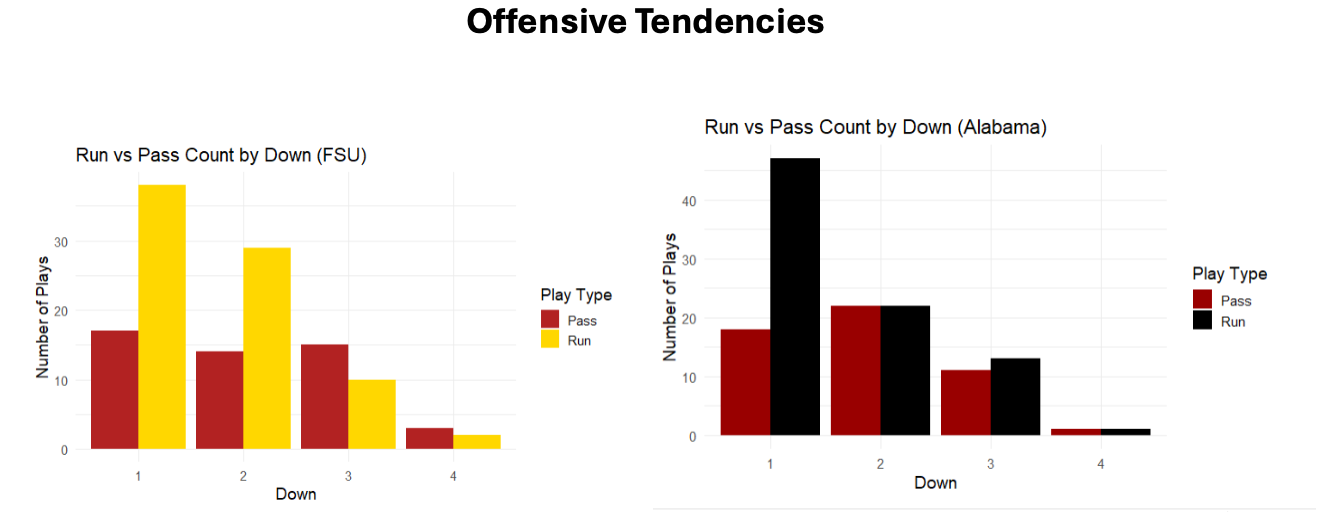
Understanding tendencies and seeing if they are working or not is important for defenses to focus on, as well as offenses to try to not repeat. As you see looking at FSU, they are a more run heavy team. First down historically is a running down for most teams, as they want to try to get half to make more manageable downs. But FSU doubles down most of the time and runs again. FSU running back Ousmane Kromah has 36 rushing attempts for 231 yards across two games averaging 6.4 yards per carry. While that is a respectable yard per carry, taking out his two longest runs of 52 and 54 yards, his yards per carry is down to 3.7, closer to average. While he has the explosiveness to break off long runs, teams are starting to understand FSU is going to run the ball no matter the down and distance. To beat a team like Alabama, FSU will have to add more passing and balance throughout to make sure they aren’t always expecting runs on the first two downs.
Alabama has played two games as well and both have been blowouts. This shows why their rushing counts are larger than their passing counts mostly. But even through the blowouts, they are going to be passing a good amount on second and third down. Getting a lead is the goal for Alabama, so they can lean on their junior running back Daniel Hill who on 27 attempts for 151 yards, is averaging 5.6 yards per carry. Alabama’s quarterback Keelon Russell is now making his third start of his college career but has only thrown for 444 yards across those two games. Playing with a lead is what he is used to, so for Florida State to disrupt their plan, they must get out to a lead in the first half just like they did in 2025. And for Alabama, their plan is to get stops with their defense, score quickly and then run the ball all through the second half.
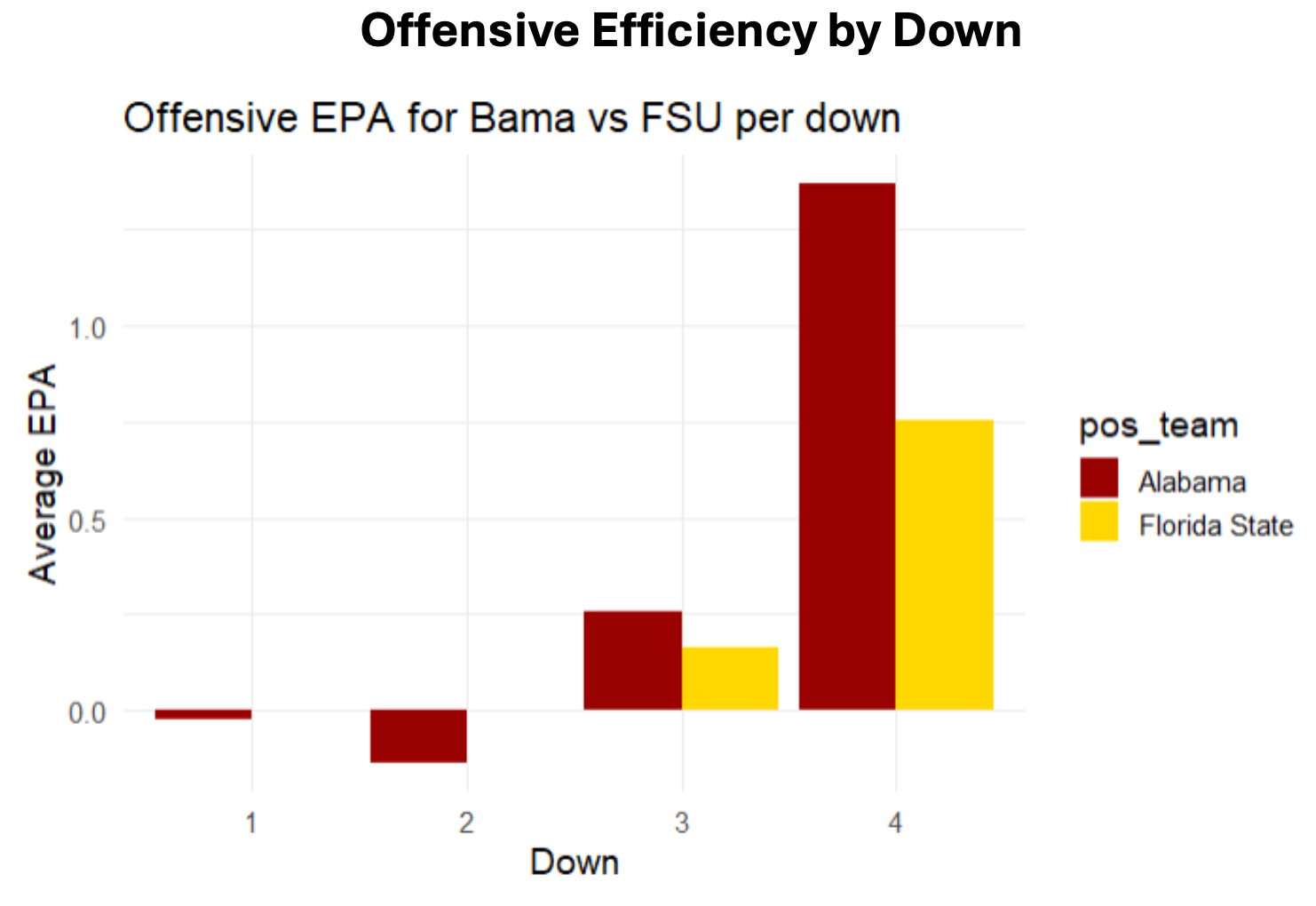
One of the greatest takeaways for understanding Average EPA (Expected Points Added) by down for each team is how Alabama is well below average team on second down. Even though above, we saw that they were a balanced passing and rushing team, this graph tells us they aren’t picking up first downs, getting sacked, negative runs, or other negative plays. First downs play part in gaining EPA towards your overall EP (Expected Points), that’s why you see more positivity towards later downs. Florida State’s part of the graph shows that they are a better offensive team by EPA for the first two downs by not having much gain in the expected points. We can justify this because FSU is a run first team, and running plays that get around 1-4 yards will give average EPAs between -0.04 – 0. And with many short runs, this can counteract the breakaway runs from Kromah that show larger gains. Alabama is going to have longer offensive drives where they will take their short gains and get to third down, but convert, where FSU is going to try to break longer runs or passes, and end up getting 3 and outs.
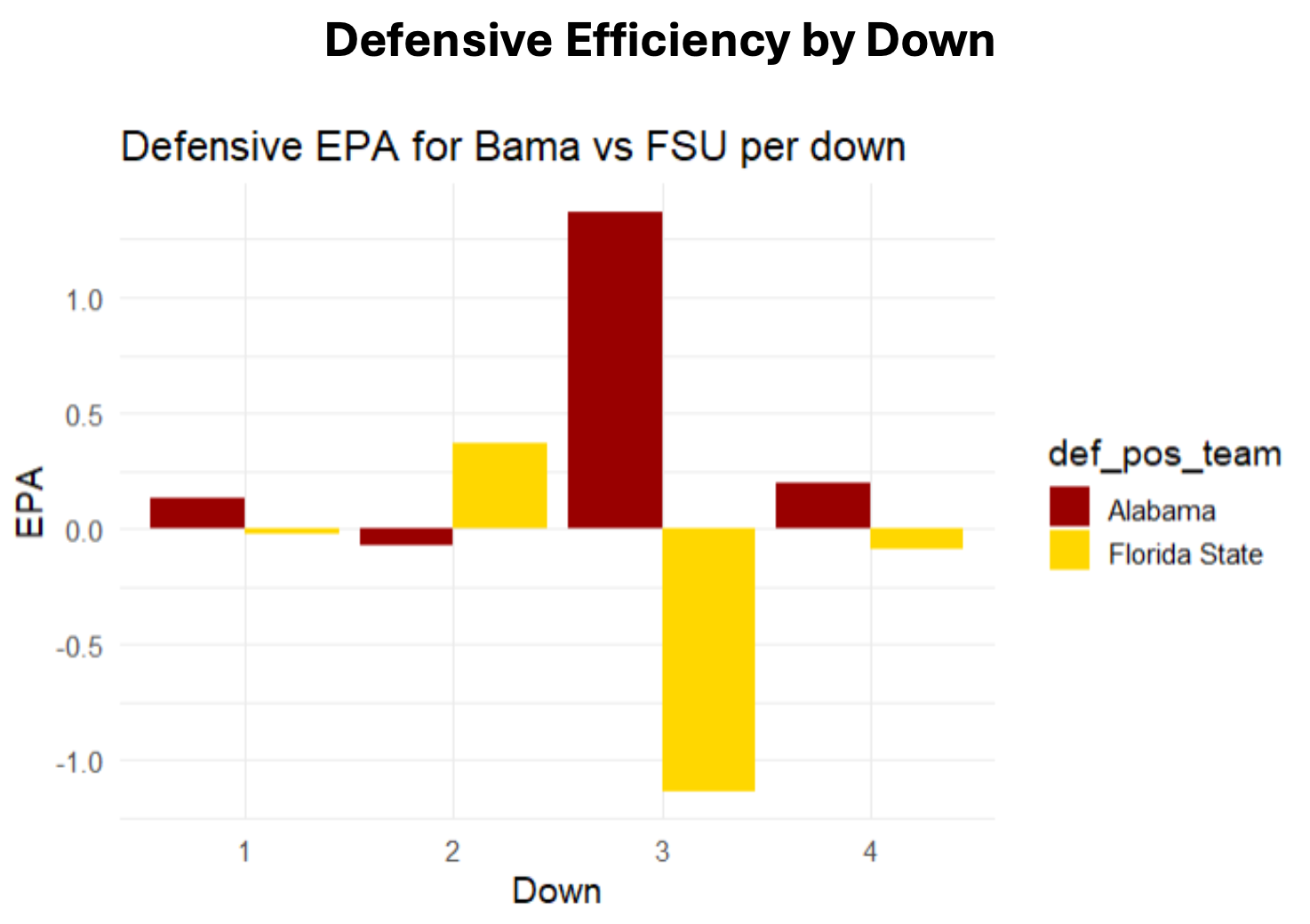
Alabama through the past couple decades has been known for defensive talent. Even though Alabama is on a new coach, this graph shows that their defense is still very good. First Down gives them the slight advantage, most likely because of their always good front seven stopping the run, but second down shows a small amount of hope for Florida State. But their third down efficiency is very good, allowing them to get off the field easily and get the ball back to their offense. And if a team must go for it on fourth down, they are efficient then and can stop you too.
Florida State on the other hand shows a different story. First down shows small EPA loss and second down is a great down for our defense. This is where we have produced our turnovers and have been able to produce some pressure towards the quarterback. The main problem is that FSU struggles to get off the field on Third down with an over -1 defensive EPA. For FSU to be able to pull off the upset against Alabama, they will have to improve their third down efficiency and continue to play good second down defense. Alabama has a good offense and can easily take advantage of bad coaching or defense from our players.
Key Takeaways
Based on the data researched above, here are the two main things FSU must do to pull off the upset for the second year in a row:
1. Create a more balanced attack on offense
Show new looks in the run and pass game
Find ways to be more efficient on early downs
2. Get out to a lead and force Alabama to become one dimensional
Get Alabama’s offense into third and long and convert
Get off the field on third down
Analytics show that both FSU and Alabama have strengths and weaknesses, and cleaning up the weaknesses and trying to exploit the other team’s weaknesses is the goal of both teams. If Florida State can dictate the tempo early and stay efficient on critical defensive downs, they can give themselves a real chance to repeat the multiple touchdown upset. Everyone knows Alabama will be prepared and try to fix their mistakes and exploit Florida State’s weaknesses, Florida State must respond with creativity and balance. Saturday will come down to execution, and the Seminoles have a opportunity to prove once again that they can win again.