
FSU Basketball: How a Defensive Surge Shows Great Promise for the Luke Loucks Era
It’s not rocket science. It doesn’t take a genius to see that Florida State Men’s Basketball is playing at a much higher level than they were at the beginning of ACC play.
The Noles looked dead in the water in early January: losing 10 of 12 games and getting boat-raced by NC State in the first real home ACC game. But after starting 0-5 in conference play, FSU has won 6 of its last 8 games and has positioned itself solidly to secure a bye in the ACC tournament. And the last 3 losses have been by a combined 7 points to solid ACC teams.
Basketball is a game of margins. Games are often decided by only a few possessions and key plays. Small adjustments can have a significant impact on the W and L category.
So what changed? How has Luke Loucks shifted the identity of a team built for shooting into one built on defense and toughness? A closer look at the stats reveals that some important numbers do a good job of representing the dramatic change in success.
We’ll be measuring FSU’s stats from the first 5 games in ACC play, and the numbers from the Miami game and beyond (every game after Wake Forest on Jan 17).
Offense
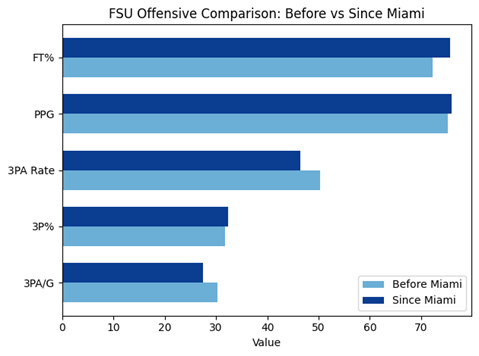
The graph above displays a few base stats from the 5-game ACC stretch before the Miami game, and the games since then.
Small increases in free-throw and 3-Point percentage are there, but not real game changers. A decrease in 3-point attempts and a bigger change in 3PA/FG are representative of FSU shifting slightly from their reliance on the three-point shot in this stretch.
Offensive Rating has seen a sizable increase as well, improving by 12 points per 100 possessions (104 to 116). Another advanced stat showing an upgrade in offensive efficiency is Effective FG%. The Noles have increased their number from 50.7% to 54.6%, a huge rise in offensive proficiency.
Another small difference can be seen in FSU’s pace. They’ve cut their possessions per game by 3.7, a considerable number for the sample size. The math works out to about a 1-second per possession increase. Nothing crazy, but significant in noticing how the Noles are trying to move towards better shots later in possessions.
One interesting number to note is the team's offensive rebound numbers. In contrast to what it might feel like, FSU has been getting fewer offensive rebounds overall and crashing the boards less (10.2 to 8.3 ORB per game, and 30.1% to 24.4% ORB%).
While getting second-chance possessions is ideal, adjusting the gameplan to prevent fewer fast-break opportunities and get back on defense has been very effective.
But by far the most important offensive numbers lie in the turnover category.
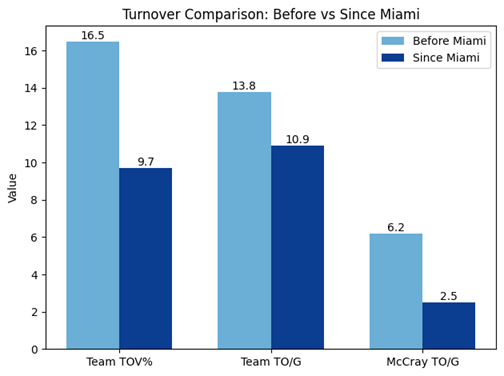
Saving extra possessions has been huge to FSU’s offensive efficiency and is crucial in preventing fast-break points for the other team as well.
Robert McCray V’s ability to limit his turnovers has been massive as well. The first 5 ACC games were very rough for him, including an 11-turnover performance in a one-point loss to Wake Forest. Since those games, McCray has averaged only 2.5 TO/G and improved his Assist/TO ratio to 2/1.
Having a more stable primary ball-handler helps the entire offense run smoothly, and the evidence is in the numbers.
This offensive jump hasn’t been about dramatic stylistic changes or a sudden scoring explosion, but much more about control. FSU is shooting slightly better, relying a bit less on the three, and crashing the glass less, but the real transformation is in possession value. Cutting nearly seven percentage points off the turnover rate has fundamentally changed the result of each trip down the floor.
Defense
The defensive stats are the real difference makers.
And rebounding has been a huge part of that success.
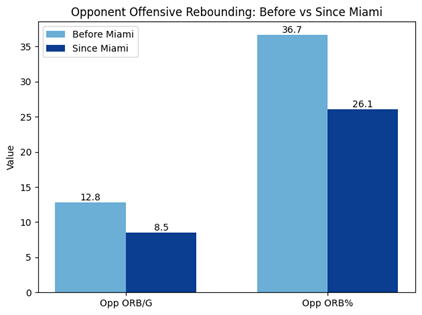
Probably the most important part of the Noles’ defensive improvement has been their ability to limit opponents' second-chance opportunities.
This graph shows us just how impressive these numbers are. Opponents' offensive rebounds per game have decreased by more than 4. Just looking at that alone, taking away 4 more opportunities for your opponents to score is huge. And that can also be seen in the opponent's offensive rebound percentage, which has seen a decrease of over 10 percentage points.
Rebounding overall has improved tremendously. Before Miami in ACC play, the Noles were losing the rebound battle by an average of 32 to 36.4 (-4.4 a game). This includes the NC State game, where there was an 18-rebound gap (easy way to get blown out).
Since the WF loss, they’ve flipped those numbers, now getting 33.6 RB per game and limiting their opponents to 29.6. (+4.0 a game).
Lajae Jones, in particular, deserves a shoutout here: boosting his rebounds from 5.8 per game to 8.5 in these 2 stretches. His development as an aggressive rebounder has been a real difference maker.
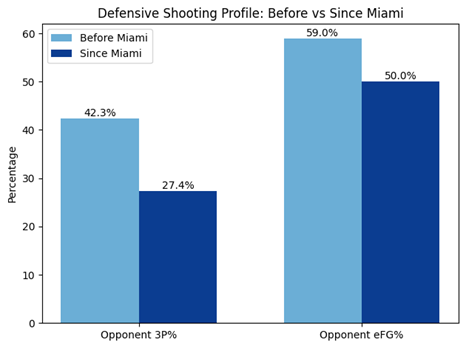
Opponents' offensive efficiency numbers tell an even bigger story.
FSU’s opponents were averaging 89.2 PPG in the first 5 ACC games. That number has been reduced to 71 PPG. Defensive rating (points per 100 possessions) has dropped from 123.1 to 102.6 as well.
What more can you say? You greatly increase your chances of victory when you don’t have to score 90 points to win.
The change in opponent 3-point percentage is honestly comical and, in part, represents teams reverting to the mean of 3-point shooting overall. The fact that one team could suffer from opponents shooting over 40% in a five-game stretch is a significant outlier among shooting numbers.
However, the Noles still deserve a lot of credit. The 27.4% number is a significant factor, and it is low despite the huge outliers in the recent VT and BC games (VT shot 50% from 3, and BC shot 45.8%).
Those improvements play a big role in the decrease in opponents' effective FG percentage. eFG values shot types more appropriately and is a great way to measure defensive efficiency, as it gives higher value to 3-point shots in its measurements.
Being able to drop that number by almost 10% is critical.
But the numbers that saw the biggest decrease/increase out of any form of measurement were the opponents’ free throws.
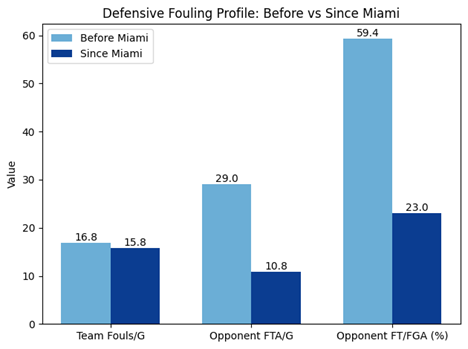
Take a look at this graph for a second.
A decrease of 1 foul per game, yet opponents are shooting almost a third of the free throws. How does a decrease of only one foul equate to 19 fewer opponent free throws?
The difference can be found in the free throws per field-goal attempt. Before Miami, opponents would shoot 59 free throws per 100 field goal attempts. Since then, the number has been cut by more than half.
Teams lower FT/FGA by contesting shots vertically and avoiding reach-ins, especially at the rim. Better on-ball defense keeps the ball in front, which prevents scrambling help situations that lead to shooting fouls. It’s less about fouling overall and more about avoiding fouls in high-value scoring areas.
That drop directly translates to fewer points, as free throws are the most efficient scoring opportunity in basketball. Before Miami, opponents were attempting about 29 free throws per game; since then, that number has fallen to just under 11. At an average FT% of around 70–75%, that improvement alone removes about 13 points per game from the scoreboard.
In other words, without changing opponents' pace or shot volume dramatically, FSU effectively erased double-digit scoring just by limiting trips to the line.
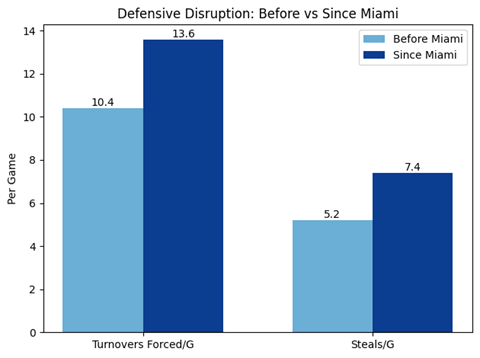
And finally, Florida State is taking the ball away at an increased rate.
Simply put, creating turnovers is crucial to the Noles’ gameplan. Creating fast break opportunities and not letting the defense get set in the half-court is exactly what Loucks wants to do.
A program built on causing chaos and turning defense into offense?
Leonard Hamilton would be proud.